How to Check Your Karta Pobytu Status Online (All 16 Offices) and Can You Speed It Up?
MOS tells you that your application was sent. It does not tell you where your case is. Each voivodeship office has its own way to check, from online portals to a hotline only. Here is what works in all 16 offices, what the statuses mean, and what a ponaglenie can and cannot do while deadlines are suspended.
8 of 16Offices with an online status tool for residence cases
8 of 16Phone or email only
0Status updates inside MOS (official UdSC Q&A)
4 Mar 2027Deadlines suspended until this date (art. 100d)
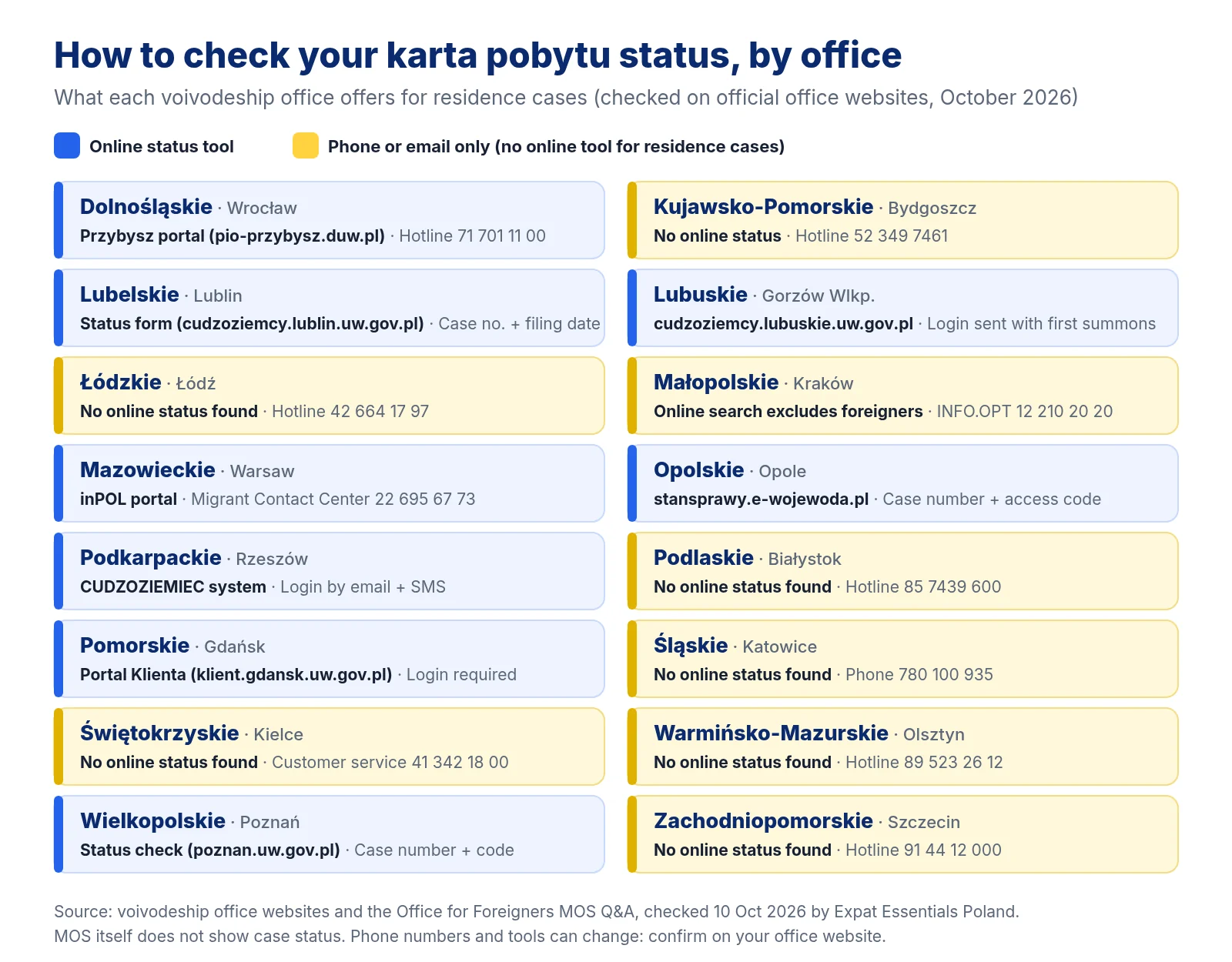
Short answer: you check your status with your voivodeship office, not in MOS. Eight offices have an online tool (for example inPOL in Warsaw, Przybysz in Wrocław, the status check in Poznań, Portal Klienta in Gdańsk). The other eight, including Kraków and Katowice, answer by phone or email. You usually need your case number (znak sprawy) and sometimes an access code from the office. A ponaglenie (formal complaint about delay) is free and you can file it, but until 4 March 2027 art. 100d means it will most likely not make your case faster.
Key facts (October 2026)
MOS does not show your case status or tell you about missing documents; the voivodeship office contacts you (Office for Foreigners, MOS Q&A).
8 of the 16 voivodeship offices offer an online status tool for residence cases; the other 8 answer by phone or email only (Expat Essentials Poland check of all 16 office websites, 10 Oct 2026).
A ponaglenie (art. 37 KPA) is free. It is addressed to the Head of the Office for Foreigners and filed through the voivode, who forwards it within 7 days; the Head of UdSC decides within 7 days.
Until 4 March 2027, art. 100d suspends deadlines in residence cases and the rules on office inaction, so a ponaglenie will most likely not speed up your case (Śląski Urząd Wojewódzki).
Foreigners waiting for a decision on temporary residence, permanent residence or EU long-term resident status from a voivodeship office (and so for a karta pobytu). If you have not applied yet, start with our MOS guide. If you want to know how long your office usually takes, see karta pobytu waiting times 2026 by voivodeship.
Residence applications are now filed online in MOS (Moduł Obsługi Spraw), the Office for Foreigners’ portal. Many people expect it to work like a parcel tracker. It doesn’t. According to the official UdSC MOS Q&A:
MOS shows only the status of the application itself: “Oczekuje na synchronizację” (being sent, takes a few minutes) and then “Przesłany” (sent). After that you download the UPO and wait for the zaświadczenie (certificate of filing), which appears next to your application in MOS.
Asked “Will MOS inform me that I need to add documents, or about the current status of my case?” the answer is simply: “No.” The voivodeship office contacts you about appearing in person and missing documents.
You cannot communicate with the office through MOS either. Letters (a new address, a new employer, a ponaglenie) go outside MOS, on paper or through the voivode’s e-Doręczenia address.
So once your application says “Przesłany” and you have your UPO and certificate (see what happens after you submit), MOS has done its job. From here on, the source of truth is your voivodeship office.
2. Your case number (znak sprawy) and access code: where to find them
Almost every office tool and hotline asks for your case number. In Polish it’s called znak sprawy or numer sprawy (lawyers sometimes say sygnatura). It is not your MOS application number, although some offices (Wrocław) use the MOS number to set up an account.
Where it is: at the top of every letter from the office, especially the first wezwanie (summons) to give fingerprints or add documents. It looks like a code with dots, e.g. SO-VII.6151.2.1234.2026. Copy it exactly, with all dots and dashes.
Access codes: several offices add a password or code. Opolskie and Wielkopolskie send it by email once the case is registered, and both let you retrieve it yourself with a form. Lubuskie generates login details with the first summons. Podkarpackie sends a login by email and SMS.
No letter yet? Then the office may not have registered your case yet. Keep your UPO and certificate, make sure your email and address in the application are correct, and check that you can receive e-Doręczenia if you use them.
Tip: save every letter as a PDF in one folder and write the case number in your phone’s notes. You will need it for the hotline, the online tools, a ponaglenie, and any letter to the office. Setting up Profil Zaufany and e-Doręczenia also makes it easier to send letters to the office online.
3. Status check by voivodeship: all 16 offices
We checked the website of each voivodeship office’s foreigners’ department on 10 October 2026. The table lists the official tool or contact for checking a residence case. Phone numbers and tools change, so confirm on the linked page before you call.
How each office lets you check a residence case. Source: voivodeship office websites and UdSC MOS Q&A, checked 10 Oct 2026.
On the hotline you type your case number on the keypad. One case per call. In inPOL, log in with the details from your office. If it shows “decyzja podpisana”, wait for SMS, email or post. Office contacts
“No online status found” means we found no public online tool for residence cases on the office’s website on 10 October 2026. Tell us if your office has launched one and we’ll update the table.
4. What the statuses mean
Each office uses its own wording, but most cases go through the same stages. Here is what they mean in plain English.
Stage
Typical wording
What it means for you
Sent (MOS)
Przesłany
Your application reached the system. Download the UPO and wait for the certificate in MOS.
Registered
Sprawa zarejestrowana / w toku / w trakcie realizacji
The office has opened a case and given it a case number. Cases are usually handled in the order they arrived.
Summons
Wezwanie (do osobistego stawiennictwa / uzupełnienia braków)
You must appear for fingerprints and show your passport, or send missing documents, by the date given. Missing it can leave your application unexamined.
Suspended
Zawieszona
The proceedings are on hold, often waiting for another authority or for you. Ask the office why.
A decision has been made. Hotlines usually won’t say whether it’s positive; wait for the letter. If it’s a refusal, read what to do after a rejection. You normally have 14 days to appeal.
Card ready
Karta gotowa do odbioru
After a positive decision the card is produced. Collect it in person (check the office’s rules for appointments).
5. Can you speed up your case? Ponaglenie vs suspended deadlines
A ponaglenie (art. 37 of the Code of Administrative Procedure, KPA) is a formal complaint that an office is not dealing with your case on time (bezczynność, inaction) or is taking longer than necessary (przewlekłość, excessive length). How it works:
It is addressed to the higher authority, which for voivodes in residence cases is the Head of the Office for Foreigners (Szef UdSC), but you file it through your voivodeship office.
It must include reasons (uzasadnienie). There is no fee.
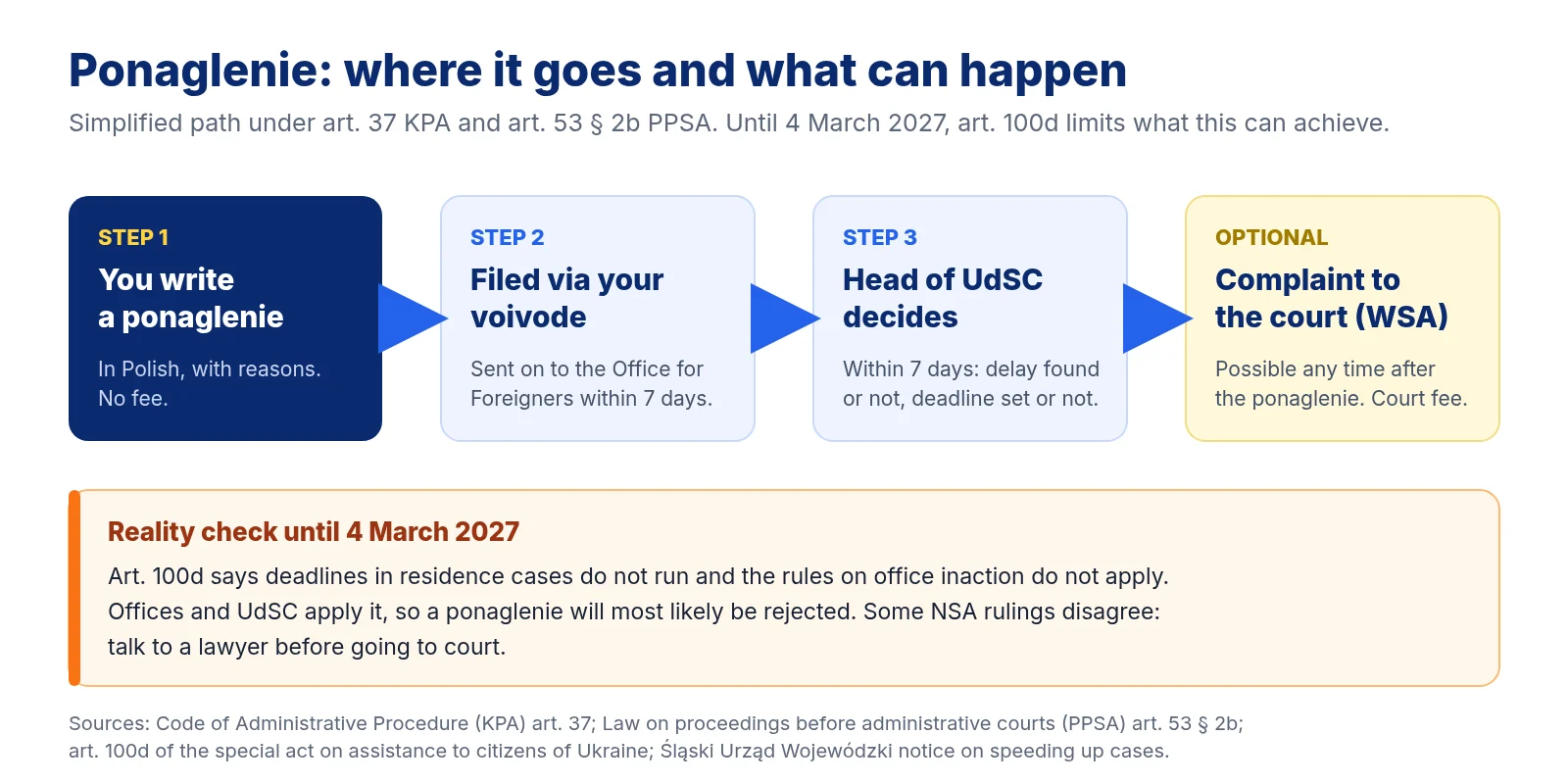
The voivode forwards it with a response within 7 days. The Head of UdSC decides within 7 days: whether there was inaction or excessive length, and if so, can set a deadline for the voivode.
Simplified ponaglenie path. Sources: KPA art. 37, PPSA art. 53 § 2b, art. 100d of the special act.
Important: a ponaglenie does not guarantee a faster decision right now. Under art. 100d of the special act on assistance to citizens of Ukraine (it applies to all foreigners), until 4 March 2027 deadlines in residence cases handled by voivodes do not run, the rules on office inaction do not apply, and delays in that period cannot be the basis for complaints about inaction or excessive length. The Śląskie office, for example, says this on its own page about ponaglenia, and the Ministry of the Interior says the Office for Foreigners applies art. 100d when it handles complaints. So expect the answer that there is no delay in legal terms. Some NSA rulings have refused to apply the extensions of the suspension (see our explanation of the 60-day deadline), but that is a matter for a court, not for the office.
What can actually help
Avoid your own delays. A complete file, a correct employer annex, appearing on the summons date and answering letters quickly are the only things fully in your control. Many “slow” cases are waiting for the applicant.
A request to speed up in exceptional situations. The Śląskie office says that in particularly exceptional (e.g. humanitarian) situations you or your representative can ask for the procedure to be sped up, with a letter giving reasons and documents proving your situation, translated into Polish. Other offices may treat such requests similarly. It is a request, not a right.
Keep your contact details up to date. A new address or email goes to the office outside MOS (paper or e-Doręczenia). A summons sent to an old address is the easiest way to lose months.
A ponaglenie can still be worth filing if your case has stood still for a very long time, or if you’re preparing for a court complaint (you need a ponaglenie first). Just know what to expect.
6. When to escalate: complaint to the court and a lawyer
After filing a ponaglenie, you can file a complaint about inaction or excessive length (skarga na bezczynność / przewlekłość) with the voivodeship administrative court (WSA), at any time (art. 53 § 2b PPSA). It is filed through the voivode, and a court fee applies.
Because of art. 100d, offices argue such complaints are unfounded, and some courts have agreed (the Śląskie office cites a 2023 judgment of the WSA in Gliwice). More recent rulings of the Supreme Administrative Court (NSA) have refused to apply the extensions of the suspension and found inaction in individual cases (see our waiting-times guide). This is exactly where you want a lawyer: talk to one before going to court, especially if your case has been pending for well over a year or the delay is causing real harm (job, family, travel). To weigh the options and their published prices, see lawyer vs relocation agency vs written help vs DIY.
7. Template: short ponaglenie in Polish + English translation
File the Polish version (the English translation is for you). Sign it and send it to your voivodeship office by post, in person, or electronically via the voivode’s e-Doręczenia address. Keep proof of sending. Replace everything in [brackets].
Polish: file this version
[Miejscowość], [data]
[Imię i nazwisko] [Adres do doręczeń] [Data urodzenia, obywatelstwo] Znak sprawy: [znak sprawy]
Szef Urzędu do Spraw Cudzoziemców za pośrednictwem: Wojewoda [nazwa województwa] Wydział Spraw Cudzoziemców [adres urzędu]
PONAGLENIE
Na podstawie art. 37 § 1 Kodeksu postępowania administracyjnego wnoszę ponaglenie w sprawie z mojego wniosku z dnia [data złożenia] o udzielenie zezwolenia na [pobyt czasowy / pobyt stały / pobyt rezydenta długoterminowego UE], znak sprawy [znak sprawy], z powodu niezałatwienia sprawy w terminie oraz prowadzenia postępowania dłużej, niż jest to niezbędne do załatwienia sprawy.
Wnoszę o: 1) stwierdzenie, że organ dopuścił się bezczynności oraz przewlekłego prowadzenia postępowania, 2) zobowiązanie organu do załatwienia sprawy w wyznaczonym terminie.
Uzasadnienie Wniosek złożyłem/złożyłam w dniu [data] za pośrednictwem systemu MOS. W dniu [data] stawiłem/stawiłam się osobiście w urzędzie (odciski linii papilarnych, okazanie paszportu). [Wszystkie wymagane dokumenty zostały złożone / Na wezwanie z dnia [data] uzupełniłem/uzupełniłam dokumenty w dniu [data].] Od tego czasu upłynęło [liczba] miesięcy, a w sprawie nie wydano decyzji. [Przedłużające się postępowanie utrudnia mi … (np. podróże do rodziny, zmianę pracy).]
[Podpis]
English translation: for your reference only
[Town], [date]
[Full name] [Address for correspondence] [Date of birth, citizenship] Case number: [case number]
Head of the Office for Foreigners via: Voivode of [voivodeship] Department for Foreigners [office address]
PONAGLENIE (COMPLAINT ABOUT DELAY)
Under art. 37 § 1 of the Code of Administrative Procedure, I file a complaint about delay in the case concerning my application of [date] for a [temporary residence / permanent residence / EU long-term resident] permit, case number [case number], because the case has not been dealt with on time and the proceedings are taking longer than necessary.
I request: 1) a finding that the authority has failed to act and has conducted the proceedings excessively slowly, 2) an order for the authority to decide the case within a set deadline.
Reasons I submitted the application on [date] via MOS. On [date] I appeared at the office in person (fingerprints, passport). [All required documents have been submitted / Following the summons of [date], I supplied the documents on [date].] Since then [number] months have passed and no decision has been issued. [The long proceedings make it difficult for me to … (e.g. visit family, change jobs).]
[Signature]
This is a general template, not legal advice. It does not mention art. 100d on purpose: the office will raise it, and arguing about it is better left to a lawyer if you go to court.
Want your letters to the office as ready, editable files?
The MOS application pack includes 17 editable letter templates (DOCX and PDF), among them a ponaglenie and a reply to a summons for missing documents (wezwanie), plus a step-by-step MOS guide if you are still preparing your application. One-time payment, ZIP by e-mail.
No. MOS shows only whether your application was sent (“Przesłany”) and gives you the UPO and the certificate of filing. The Office for Foreigners confirms that MOS does not inform you about missing documents or the status of your case. Check with your voivodeship office instead.
How do I check my karta pobytu status in Warsaw?
Through the inPOL portal of the Mazowieckie office, or by calling the Migrant Contact Center on 22 695 67 73 (Mon–Fri 8:00–15:00) and typing your case number on the keypad.
Where do I find my case number?
At the top of letters from the voivodeship office, especially the first summons. It is called znak sprawy or numer sprawy and is different from your MOS application number.
Will a ponaglenie speed up my karta pobytu?
Not reliably. Until 4 March 2027, art. 100d says deadlines in residence cases do not run and the rules on inaction do not apply, so a ponaglenie will most likely be rejected. It is free and is required before a court complaint, so it can still make sense in a very long case.
Does the hotline tell me if my decision is positive?
Usually not. For example, Warsaw’s Migrant Contact Center does not say what kind of decision was issued. If the status says the decision is signed or the case is closed, wait for the letter.
Can I write to the office through MOS?
No. Letters to the office, including a ponaglenie or a change of address, go on paper or to the voivode’s e-Doręczenia address.
How long does a ponaglenie take?
The voivode should forward it to the Head of the Office for Foreigners within 7 days, and the Head of UdSC should decide within 7 days of receiving it (art. 37 KPA). Because of art. 100d, the answer will most likely be that there is no delay in legal terms.
Your employer must give you a świadectwo pracy on the day your job ends. What it must contain, how to fix mistakes within 14 days and what to do if you do not get it, with a deadline checker and Polish letters.
Severance pay in Poland is 1–3 months of pay after a layoff at an employer with 20+ staff, capped at 72,090 zł in 2026. Retirement and death severance, a calculator, Polish letters and rules for foreign workers.
Polish citizenship granted by the President in 2026: who can apply, the 1,669 zł fee, what the application must contain, children, and how it differs from recognition.
Does Poland have a digital nomad visa? No. What remote workers can use instead in 2026, why the JDG route is closed to most non-EU citizens, and tax basics.
Sometimes the language. Sometimes a useful service. Sometimes help with a process that is free at the official source. Here is how to tell the difference.
Help us make our guides better. We use essential cookies to run this site. If you agree, we also use analytics cookies to see which guides actually help expats, and marketing cookies to measure our ads. You can change your choice anytime in Cookie settings in the footer.