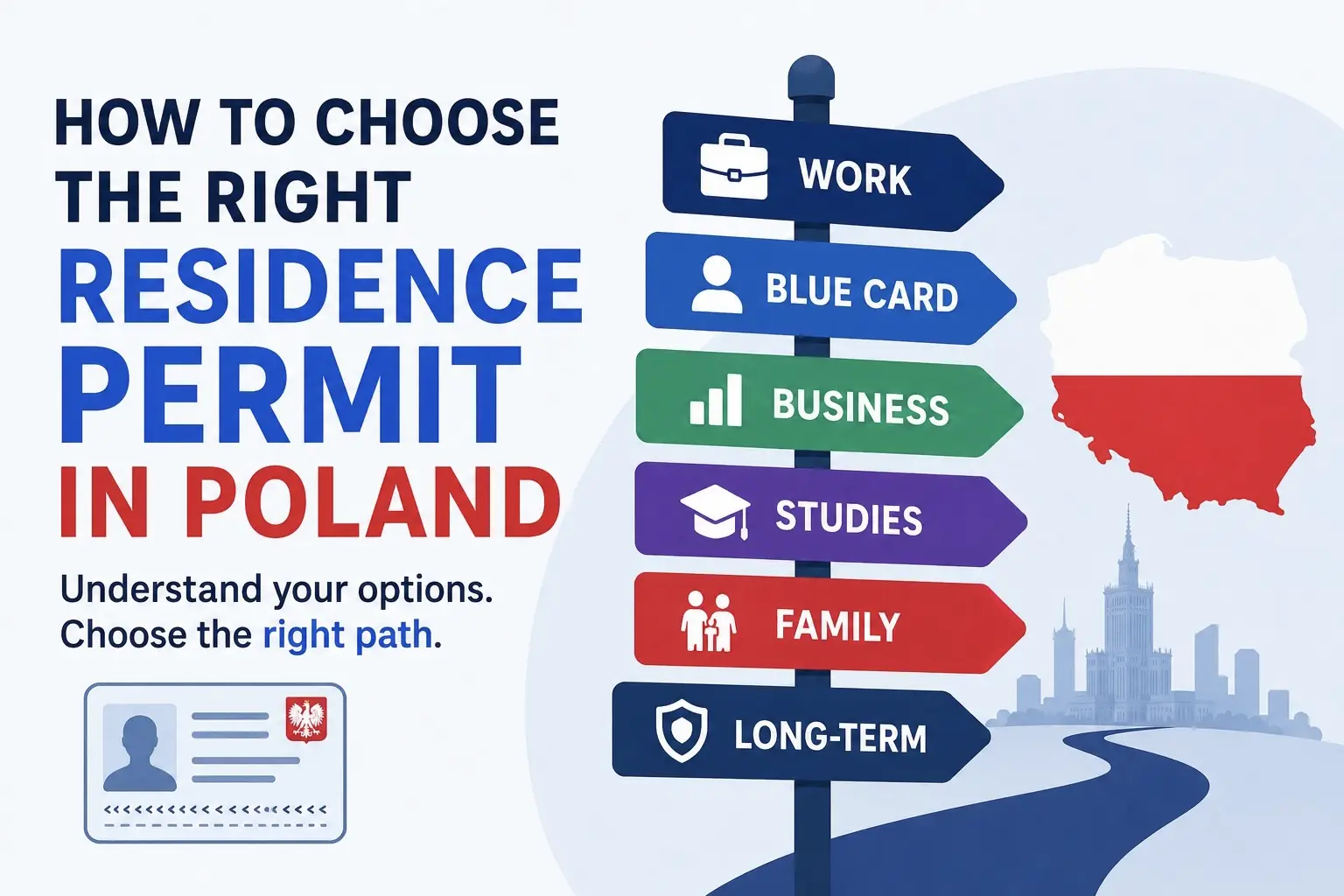
How to Choose the Right Residence Permit in Poland
Not sure which Polish residence permit you need? The right option depends on
why you are staying in Poland, your citizenship, your current status and your long-term plans.
This guide explains the main residence routes and shows you what to consider before applying.
17Main temporary-stay purposes listed by MOS
2026New electronic MOS application system
3Main long-term pathways to understand
Quick answer:
There is no single “Poland residence permit.” Your permit should match the
main purpose of your stay. Common routes include work, highly qualified employment,
business, studies, family, permanent residence and EU long-term resident status.
WorkResidence and work routes
StudyUniversity and education
FamilyFamily-based residence
Long-termPermanent or EU long-term residence
Who this applies to
This guide is for foreigners comparing Polish residence routes for work, Blue Card, study, business, family or long-term residence. The correct route depends on your citizenship, purpose of stay and current legal status.
1. Quick Answer: Which Residence Permit Should You Choose?
The best residence route is normally determined by the main purpose of your stay in Poland.
You should not choose a permit simply because it sounds easier or because another foreigner used the same route.
WorkingI am working in Poland
Look at temporary residence and work routes, depending on your employment situation and eligibility.
Highly qualifiedI have a highly qualified job
The EU Blue Card may be relevant if you meet the specific salary, qualification and employment requirements.
BusinessI run or want to run a business
Business-related temporary residence may be appropriate when your stay is connected with business activity in Poland.
StudyI am studying
A student route may apply when studies are the main purpose of your stay.
FamilyI am joining family
Family-based residence depends on who your family member is and their status in Poland.
Long-termI want to stay permanently
Permanent residence or EU long-term resident status may become relevant if you meet the applicable requirements.
2. Which Polish Residence Permit Do I Need?
Start with the question: “Why am I staying in Poland?”
Your answer should lead you toward the correct category.
Your situation
Route to investigate
Typical purpose
Employed by a Polish employer
Temporary residence and work
Employment
Highly qualified employment
EU Blue Card
Highly qualified work
Running a business
Business-related temporary residence
Business activity
University or other qualifying studies
Student residence
Studies
Joining eligible family in Poland
Family-based residence
Family life / reunification
Specific temporary circumstances
Relevant temporary residence purpose
Other qualifying circumstances
Long-term settlement
Permanent residence
Permanent stay
Long-term legal residence in the EU
EU long-term resident status
Long-term residence
Important:
This table is a starting point, not a legal eligibility test. The exact requirements,
exclusions and documents depend on your individual circumstances.
3. Visa vs Residence Permit vs Residence Card
These terms are often confused, but they describe different things.
Document / status
What it means
Visa
Allows a foreign national to enter and/or stay in Poland for the period and purpose covered by the visa.
Residence permit
The legal basis for a foreigner’s residence under the applicable residence procedure.
Residence card
A physical document confirming certain residence rights and used together with a valid travel document.
Think of it this way:
the permit is about your legal residence status, while the residence card is the physical document
you use to demonstrate that status.
The EU Blue Card is designed for highly qualified employment and has specific
eligibility conditions.
It should not be treated simply as a “better” version of the standard work permit.
The Blue Card has its own requirements concerning employment, qualifications and remuneration.
Best starting point:
If you have a highly qualified job offer and meet the relevant criteria,
compare the Blue Card route with the ordinary temporary residence and work route before applying.
6. Residence Based on Business Activity
Foreign nationals whose main purpose of stay is connected with business activity may be able
to use a business-related temporary residence route.
The important point is that simply having a registered company does not automatically mean that
a foreigner qualifies for residence on that basis.
Consider
The legal form of your business.
Your actual involvement in the business.
The economic activity and its results.
The applicable residence requirements.
Whether another residence purpose better describes your situation.
If you are deciding between employment and business residence, do not choose based only on
which application appears shorter. The correct route is the one supported by your actual situation.
7. Residence for Studies
Students may qualify for a temporary residence route when studies are the main purpose of their stay.
Your educational institution, type of studies, programme and personal circumstances can affect
the applicable requirements.
Do not confuse admission with residence permission.
Being accepted by a university does not by itself answer every immigration requirement.
Check the residence procedure separately.
8. Family-Based Residence in Poland
Family-related residence depends heavily on who your family member is and what status they have in Poland.
Family member of a Polish citizen
Different rules may apply depending on the relationship and circumstances.
Family reunification
Specific requirements apply when joining a qualifying foreign resident in Poland.
Family member of an EU citizen
EU free-movement rules can create a different residence framework.
Family outside Poland
Some family procedures have special rules concerning applications made from outside Poland.
Important:
Family residence is one of the areas where the exact relationship and the status of the sponsor
can fundamentally change the procedure.
9. Other Temporary Residence Routes
The Polish immigration system includes more temporary-stay purposes than work, studies and family.
The current MOS system lists 17 main purposes for temporary residence.
Depending on your circumstances, these can include areas such as:
Do not use “Other circumstances” as a generic shortcut.
If your main purpose does not fit one of the listed categories, the relevant legal requirements
still have to be satisfied.
10. Permanent Residence in Poland
A permanent residence permit is different from a temporary residence permit.
It is intended for qualifying foreign nationals who have a legal basis for permanent residence.
Eligibility depends on your individual circumstances and the legal category under which you apply.
There is no universal “after X years everyone gets permanent residence” rule that applies to every foreigner.
Before considering permanent residence
Check whether you have a legal basis for permanent residence.
Check your previous residence history.
Check language and integration requirements where applicable.
Check the documents required for your specific legal basis.
11. EU Long-Term Resident Status
EU long-term resident status is another long-term residence route, but it is not identical
to a Polish permanent residence permit.
The requirements can include a qualifying period of residence, stable and regular income,
health insurance and other conditions, depending on the circumstances.
Why the distinction matters:
“Permanent residence” and “EU long-term resident” are separate legal statuses.
If your long-term goal is to settle in Poland, compare both routes against your personal situation.
12. What If You Are an EU, EEA or Swiss Citizen?
If you are a citizen of the EU, EEA or Switzerland, the residence framework is different from
that applicable to most non-EU nationals.
EU citizens generally exercise free-movement rights and may need to register their residence
after the relevant period of stay.
The Polish government provides information about registration of EU citizens’ residence here:
Registration of residence
.
If you are an EU citizen:
do not automatically follow a non-EU residence-permit checklist.
Your procedure can be fundamentally different.
Old EU residence documents expired after 3 August 2026.
If you still hold a paper registration certificate, permanent-residence document, residence card for an EU citizen’s family member or permanent-residence card for a family member issued on an old template by 1 August 2021, that document is no longer valid. Apply to the competent voivode for a new document. This does not by itself cancel your underlying EU residence or permanent-residence right as long as you still meet the legal conditions.
Office for Foreigners — expired pre-August-2021 document templates ↗
13. What Documents May You Need?
The exact document list depends on the residence purpose. There is no single universal
“residence permit document checklist”.
Document / evidence
Why it may matter
Passport
Identity and travel document information.
Digital photograph
Required for the application process according to applicable specifications.
Proof of payment
Relevant administrative fees must be paid and evidence attached as required.
Employment documents
Relevant for work-related residence routes.
Education documents
Relevant for study-related routes.
Family documents
May establish qualifying family relationships.
Income / insurance evidence
May be required depending on the residence procedure.
14. Can You Apply for a Residence Permit From Inside Poland?
In many temporary residence procedures, an application can be submitted while you are legally
staying in Poland, provided the applicable conditions are met.
The timing is extremely important. For procedures requiring an application before the end of
legal stay, submitting too late can create serious problems.
Do not wait until the last day if you can avoid it.
Your procedure may involve documents from an employer, university, family member or another party,
and incomplete preparation can create additional problems.
Some procedures also have special rules or exceptions concerning applications made from outside Poland.
Always check the specific procedure rather than assuming the same rule applies to every residence route.
15. MOS in 2026: Poland’s New Electronic Residence System
Poland launched the new MOS system on 27 April 2026.
For residence procedures covered by the new electronic system, applications are submitted
electronically through MOS, subject to specified exceptions.
You authenticate through login.gov.pl where required.
The application form is completed in Polish.
You provide the required digital documents and scans.
Required third-party documents may need electronic signatures.
An adult applicant with full legal capacity must personally sign the application using an accepted electronic signing method; a procedural proxy cannot sign it instead. A statutory representative signs only where the applicant lacks full legal capacity.
After successful submission, you can save the relevant confirmation documents.
The official government information about MOS is available through the
Office for Foreigners
.
One important warning: a full-capacity adult must personally sign the MOS application. Giving someone a power of attorney for the later proceedings does not allow that person to sign the residence application in MOS. A statutory representative may sign only where the applicant lacks full legal capacity.
Administrative fees depend on the type of residence procedure.
Current official information states that the stamp duty for residence applications can be
340–640 PLN depending on the permit, while issuance of a residence card
is subject to a separate fee.
340–640 PLNExample range for stamp duty depending on permit
100 PLNResidence-card issuance fee stated by official guidance
SeparatePayments are handled separately from the MOS application itself
Check firstExact fee depends on your procedure
Always verify the current fee for your specific procedure before paying.
17. 10 Common Residence Permit Mistakes
Choosing a permit based on someone else’s situation.
Confusing a visa with a residence permit.
Assuming a residence card is the permit itself.
Using an incorrect residence purpose.
Waiting until the end of legal stay.
Submitting incomplete documents.
Ignoring documents that must come from another person or institution.
Assuming every procedure can be submitted electronically in exactly the same way.
Relying on old immigration information.
Choosing the easiest-looking route instead of the route that matches the actual situation.
18. What Should You Do Next?
Once you know the general category, the next step is to turn that information into an actual
sequence of actions.
STEP 1 — Define your main purpose
Work, highly qualified work, business, studies, family or another qualifying circumstance.
STEP 2 — Check your citizenship
EU/EEA/Swiss and non-EU nationals can follow different residence frameworks.
STEP 3 — Check your current legal status
Your current visa, residence status and location can affect what you can apply for and when.
STEP 4 — Check the official procedure
Use the relevant MOS checklist and current government information.
STEP 5 — Prepare your documents
Identify which documents you already have and which must be obtained from your employer,
university, family member or another organisation.
STEP 6 — Check deadlines and fees
Do not leave legal-stay deadlines or administrative payments until the last moment.
What residence permit do I need to work in Poland?
If employment is the main purpose of your stay, a temporary residence and work route may be relevant.
The exact procedure depends on your employment and immigration situation.
Is the EU Blue Card the same as a work residence permit?
No. The EU Blue Card is a separate route for qualifying highly qualified employment and has
specific eligibility requirements.
Can I choose any residence permit I want?
No. Your application should correspond to the actual main purpose and legal basis for your stay.
Is a residence card the same as a residence permit?
No. The residence card is the physical document associated with your residence status.
Can EU citizens apply for a Polish residence permit?
EU citizens generally follow the EU free-movement residence framework rather than the standard
non-EU temporary residence permit system.
Can I apply for residence while I am already in Poland?
Many residence procedures can be initiated from inside Poland when the applicable requirements
are met, but there are exceptions and procedure-specific rules.
Do I need to use MOS in 2026?
Since 27 April 2026, covered residence procedures are submitted electronically through the new
MOS system, subject to specific exceptions.
How much does a Polish residence permit cost?
The administrative fee depends on the type of permit. Current official information gives a
stamp-duty range of 340–640 PLN depending on the permit, plus a separate residence-card fee where applicable.
What if I still don’t know which residence route applies to me?
Start with your citizenship, current residence status, main purpose of stay and long-term goal.
If you want these factors organised into a personalised roadmap, you can use the
free EEP app
.
Temporary residence permits (zezwolenie na pobyt czasowy) are the most common type for non-EU citizens staying over 3 months. Maximum validity is 3 years, renewable indefinitely as long as the grounds for stay continue to exist. You are applying for a new permit each time — not a simple renewal.
The 6 Temporary Permit Subtypes
💼 Temporary Residence & Work
Most Common · Up to 3 years
This is a single temporary residence-and-work procedure: the foreigner applies for the combined permit through MOS, while the employer provides the employment information and supporting documents required for the application. Do not confuse it with a separate employer work-permit application through praca.gov.pl. A change of employer or relevant employment conditions can require a permit amendment or another residence/work procedure, depending on the case.
Minimum salary: 4,806 PLN gross/month (Jan 2026)
Written employment contract for the full permit period
Supporting evidence required for the work-residence route; verify the current MOS checklist for insurance, accommodation and employment documents
🎓 Temporary Residence for Study
Students · Annual renewal
For qualifying full-time students in Poland. There is no general 20-hours-per-week ceiling attached to the student work-permit exemption. From 1 July 2026, the general exemption is limited to qualifying full-time students at institutions that meet the statutory approval/exemption conditions. If the institution or study mode does not qualify, a separate work-authorisation basis may be needed.
Proof of university enrolment (letter of acceptance)
Proof of financial means to cover tuition + living costs
Health-insurance proof in the form accepted for the study route — public-healthcare entitlement or insurer coverage of medical-treatment costs in Poland
🏢 Temporary Residence for Business
Entrepreneurs · Up to 3 years
For non-EU citizens running a registered Polish business (JDG or sp. z o.o.). Must demonstrate the business is genuinely active, generating income, and contributing to the Polish economy. More documentation-intensive than work permits.
KRS or CEIDG business registration
Proof of business activity (invoices, contracts, bank statements)
Business/economic and financial evidence required by the current business-residence route — check the current MOS thresholds and performance conditions
👨👩👧 Temporary Residence — Family
Family Reunification · Linked to sponsor
For spouses, minor children, and dependent family members of Polish citizens, EU citizens with registered residence, or non-EU residence permit holders. Validity is linked to the sponsor’s permit. Grants access to the labour market (right to work without separate work permit).
Proof of family relationship (marriage certificate, birth certificate)
Sponsor’s valid residence permit or Polish citizenship proof
Proof of shared household
📚 Graduate Permit (Job Seeker)
Post-graduation · 9 months · One-time
A one-time permit for graduates of Polish universities who want to stay and look for work after completing their degree. Valid for 9 months — non-renewable. During this period you may work without a separate work permit.
Proof of degree completion from accredited Polish university
Previous valid student residence permit
Financial means for 9 months of stay
🌐 Temporary Residence — Other Grounds
Miscellaneous purposes
Covers all other legitimate reasons for extended stay: voluntary work, NGO activities, medical treatment, participation in cultural/sports programs, or other justified personal circumstances. Evaluated case by case by the voivodeship office.
Purpose-specific documentation proving grounds
Proof of financial means and accommodation
Health-insurance evidence in the form required for the specific “other circumstances” route
Formal Filing Basics — Then Check Your Exact Route
There is no single document checklist for every temporary residence permit
The purpose of stay determines the substantive evidence. Work, study, family, business, graduate, research and other routes have different requirements for income, insurance, accommodation and supporting documents.
🏅 Permanent Residence Permit Specific Statutory Routes
A Polish permanent residence permit (zezwolenie na pobyt stały) is granted for an indefinite period, but it is not a general status automatically available after five years of ordinary residence. It is available only in the categories specified by law.
Do not confuse permanent residence with EU long-term resident status
The general “5 years of legal and continuous residence” route belongs mainly to the EU long-term resident permit. Permanent residence has category-specific grounds and, for some categories, a different required period of prior residence or no general five-year requirement at all.
Main statutory routes
Status and document
The permit itself is indefinite. The physical residence card is a separate document and must be replaced/renewed according to the document-validity rules.
🌍 EU Long-Term Resident Permit Usually 5 Years + B1 Polish
The EU long-term resident permit is an indefinite Polish residence status created under EU law for eligible third-country nationals who have lived legally and continuously for the required period and meet the additional conditions.
Core requirements
EU mobility — useful, but not automatic free movement
EU long-term resident status can make it easier to obtain residence in another participating EU Member State for work, study or other qualifying purposes, but it does not by itself give an automatic right to move and work anywhere in the EU without completing the destination country’s procedure.
Status and card
The Polish EU long-term resident permit is granted for an indefinite period. The physical residence card is issued for a limited period and must be replaced periodically.
The EU Blue Card is a combined residence and work permit specifically for highly qualified non-EU professionals. Following the EU Blue Card recast directive implementation in 2026, Poland has significantly lowered barriers to entry and expanded rights for Blue Card holders.
2026 Blue Card — Key Changes
Parameter
Before 2026
From 2026 (Recast)
Salary Threshold
12,272 PLN gross/month
more than 13,355.34 PLN gross/month (160,264.08 PLN gross/year for 2026 applications)
Qualification Requirement
University degree only
Degree OR equivalent professional experience
Processing Time
Up to 90 days
Capped at 60 days
Business Ownership
Prohibited for Blue Card holders
Permitted — can own/run a business
EU Mobility
12 months in Poland before moving
12 months in Poland; simplified procedures for other EU countries
Contract Requirement
12-month minimum contract
Shorter minimum contract (national law being updated)
Blue Card Eligibility Checklist
⭐ Advantages of EU Blue Card Over Standard Work Permit
Combined permit: One application grants both residence and work rights — no separate work permit needed
Faster path to EU Long-Term Residence: Blue Card holders need only 2 years of stable income (vs. 3 years for standard permit holders)
EU mobility: After 12 months in Poland, can relocate to another EU member state to work
Business ownership: Can own and operate a business alongside employment (new from 2026 recast)
Family-friendly: Spouse/children get residence permit with full labour market access immediately
60-day processing cap: Faster legal certainty than some standard permit applications
⭐ Special Permits Pole’s Card, Graduate & Humanitarian
Pole’s Card (Karta Polaka)
🇵🇱 Pole’s Card — Important residence route
Karta Polaka confirms belonging to the Polish Nation; it is not a residence permit, citizenship document or border-crossing document. An eligible holder who intends to settle permanently in Poland may apply for permanent residence without a general one-year waiting period. A valid Karta Polaka also exempts its holder from the work-permit requirement. Applications for Karta Polaka are normally handled by the competent Polish consul and, for categories designated by regulation, by an authorised voivode in Poland. Eligibility is based on the statutory Polish-identity/ancestry or qualifying Polish-organisation criteria — it is not limited simply to citizens of former USSR states.
Graduate Permit
🎓 Graduate Permit — 9 Months to Find a Job
This is a one-time 9-month temporary residence permit for eligible graduates of Polish higher-education institutions who, directly after studies, want to stay to look for work or prepare to start a business. It is not renewable. The residence permit itself does not create a universal right to work; a separate work permit is unnecessary only where the graduate falls within a statutory work-permit exemption. Do not describe this as a “5-year permanent-residence” clock: permanent residence requires a separate statutory ground, while EU long-term resident status has its own detailed residence-counting rules.
Humanitarian & Tolerated Stay Permits
🛡️ Humanitarian Reasons & Tolerated Stay
Humanitarian Reasons: Granted when deportation would expose a person to severe harm, persecution, or violation of human rights, but formal refugee status criteria are not met. Granted indefinitely; card renewed every 2 years. Grants right to work and access social benefits. Can be withdrawn if circumstances change.
Tolerated Stay: Issued when deportation is temporarily impossible or inadvisable (e.g., no diplomatic relations with country of origin, temporary instability). Valid 2 years, renewable. More limited rights than humanitarian permit. Does not count toward permanent residence timeline.
Applications: Both are granted automatically as part of deportation/asylum proceedings — you do not apply for them independently. Processed by the Border Guard (Straż Graniczna) and UDSC.
Belarus-border international-protection restriction — September 2026: Poland has extended the temporary restriction on lodging applications for international protection at the state border with Belarus for another 60 days from 18 September 2026. This is not an absolute ban: statutory exceptions remain, including for unaccompanied minors, pregnant women, people who may require special treatment because of age or health, certain people facing a clear risk of serious harm, and citizens of the state carrying out the instrumentalisation. Check the current Office for Foreigners guidance before relying on this route.
📊 Side-by-Side Comparison All Permits
Permit / status
Work
Business
Family
Long-term residence note
EU mobility
Temporary — Work
Work rights follow the combined permit and its conditions
Not automatically granted by this permit
Family routes may be available if statutory conditions are met
Can contribute to EU long-term resident history, subject to the detailed counting rules
No automatic EU-wide residence/work right
Temporary — Family
Many qualifying family-reunification permits give labour-market access without a separate work permit; check the exact basis
Depends on the holder’s statutory status and business rules
This is itself a family-based residence route
Counting depends on the exact residence basis and EU long-term rules
No automatic EU-wide residence/work right
EU Blue Card
Yes, under the Blue Card employment rules
Check the current Blue Card/business rules before relying on this status for self-employment
Facilitated family-reunification rules can apply
Special EU long-term “2+3” residence-counting rules can apply to qualifying Blue Card mobility
Facilitated Blue Card mobility after the statutory conditions are met; the destination-state procedure still applies
Permanent Residence
Unrestricted access to the Polish labour market
May conduct business under the applicable Polish rules
Can support qualifying family-reunification routes
Indefinite Polish residence status based on a specific statutory ground
Does not itself create EU-wide permanent residence; normal Schengen travel rules apply
EU Long-Term Resident
Unrestricted access to the Polish labour market
May conduct business under the applicable Polish rules
Can support qualifying family-reunification routes
Indefinite Polish status after meeting the qualifying residence, income, insurance and language rules
Facilitates residence in other participating EU states, but the destination state’s procedure still applies
Karta Polaka
Exempt from the Polish work-permit requirement while legally staying in Poland
May conduct business on the statutory terms available to Karta Polaka holders
No automatic residence status for family members solely from the card
An eligible holder intending to settle permanently may apply for Polish permanent residence without a general one-year waiting period
Karta Polaka itself is not an EU residence status or border-crossing document
🗺️ Long-Term Residence Pathways No One Universal Timeline
The key distinction
Five years of ordinary legal residence does not automatically make every non-EU foreigner eligible for permanent residence. After a qualifying five-year residence history, the status to check is usually the EU long-term resident permit. Permanent residence requires a separate statutory ground.
1
Choose the correct current residence basis
Use the visa, temporary residence permit or other status that matches your actual purpose of stay. Keep decisions, cards, travel records and evidence of absences because later long-term applications depend on how your residence history is counted.
2
Build a qualifying residence history
For EU long-term resident status, the usual benchmark is five years of legal and continuous residence immediately before applying, but some periods count only partly and some residence bases are excluded. Blue Card holders can have special EU-mobility counting rules.
3
At around five years, check EU long-term resident eligibility
Do not rely on the calendar alone. Check the counting rules, B1 Polish evidence, stable and regular income history, health insurance and the other current MOS requirements.
4
Check permanent residence separately
You may qualify earlier or on a different timeline if you have a statutory ground — for example Polish origin or Karta Polaka, qualifying marriage to a Polish citizen, an eligible child/family basis, or one of the specified protection or trafficking categories.
5
Citizenship is a separate procedure with several routes
Recognition as a Polish citizen does not follow one universal “year 8” rule. Examples include 3 years of continuous residence on permanent/EU long-term/permanent-right status plus stable income and a legal title to housing; a 2-year route combined with at least 3 years of marriage to a Polish citizen; and a 1-year route for people holding permanent residence obtained because of Polish origin or Karta Polaka. Recognition generally requires officially confirmed Polish at B1 level.
Karta Polaka / Polish origin
If you hold a valid Karta Polaka or qualify on Polish-origin grounds and intend to settle in Poland, MOS states that you may apply for permanent residence while legally staying in Poland; there is no general one-year waiting period before the permanent-residence application itself.
Who can turn temporary protection (PESEL UKR) into a 3-year CUKR residence card, how to apply in MOS, fees, timelines and common mistakes. Checked against official sources.
The law gives Polish voivodeship offices 60 days to decide on temporary residence. Official replies from 10 offices show 2026 averages of 250 to 539 days, up to 9 times longer. Office-by-office data and what it means if you're waiting.
Sometimes the language. Sometimes a useful service. Sometimes help with a process that is free at the official source. Here is how to tell the difference.
Help us make our guides better. We use essential cookies to run this site. If you agree, we also use analytics cookies to see which guides actually help expats, and marketing cookies to measure our ads. You can change your choice anytime in Cookie settings in the footer.